

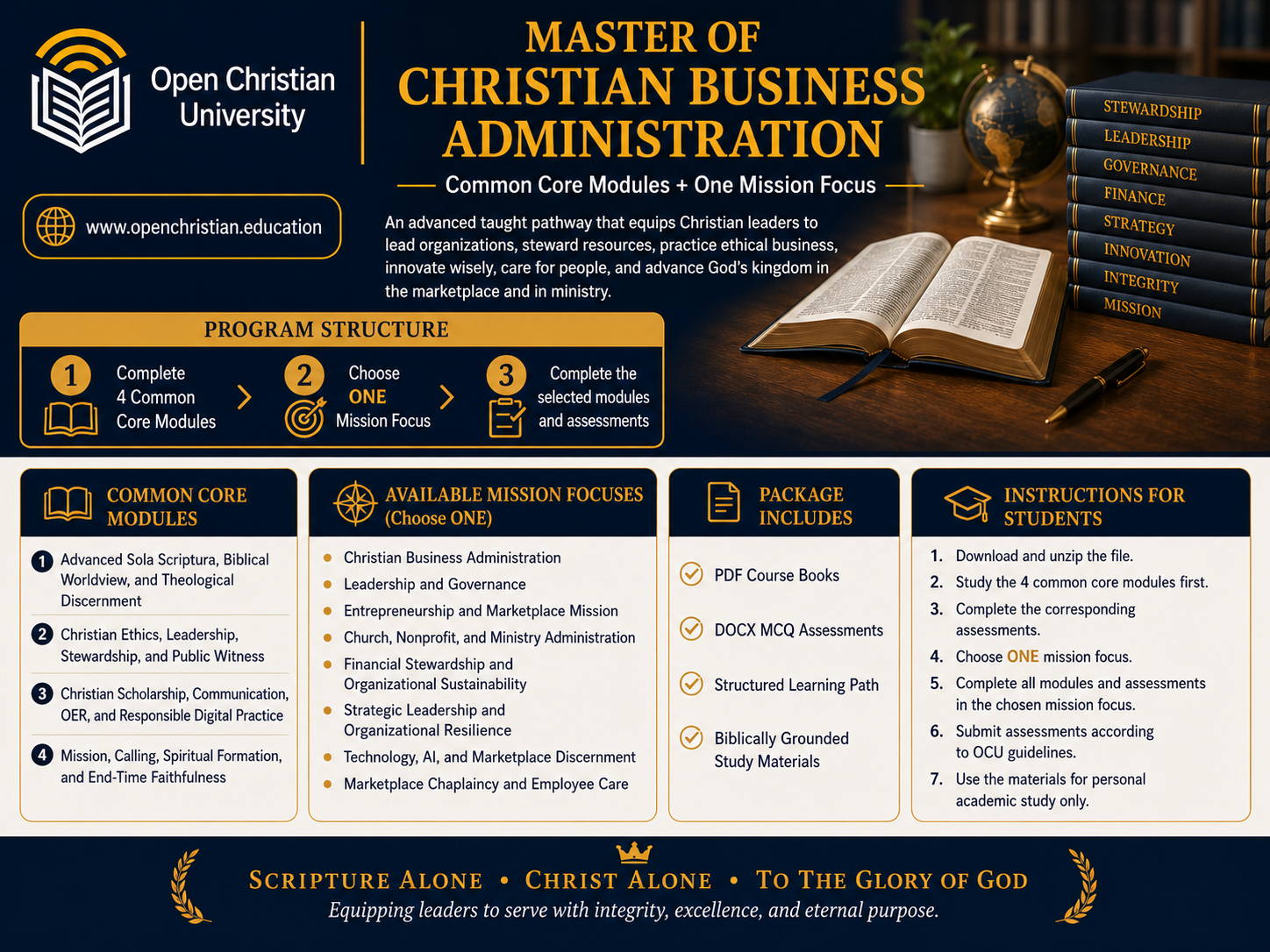
Master of Christian Business Administration: Complete Curriculum Materials
The Master of Christian Business Administration is a 60-credit taught graduate pathway designed to equip Christian leaders, entrepreneurs, ministry administrators, nonprofit workers, business professionals, workplace servants, and institutional leaders to serve Christ faithfully through business, governance, stewardship, innovation, financial accountability, organizational resilience, technology discernment, and marketplace witness.
Students complete 24 credits of common graduate formation through four shared modules, then choose one 36-credit mission focus made up of six advanced modules. Each course carries 6 credits, giving a total of 10 taught graduate courses. This master pathway is course-based and does not require a dissertation, thesis, capstone, portfolio, or major project.
This downloadable package includes 52 PDF course books and 52 DOCX MCQ assessments: 4 common graduate modules and 8 available mission-focus options, each with 6 course books and 6 assessments.
Common Graduate Formation Modules
All students begin with these four shared modules:
- MGF501 Advanced Sola Scriptura, Biblical Worldview, and Theological Discernment
- MGF502 Mission, Calling, Spiritual Formation, and End-Time Faithfulness
- MGF503 Christian Ethics, Leadership, Stewardship, and Public Witness
- MGF504 Christian Scholarship, Communication, OER, and Responsible Digital Practice
These common modules provide the biblical, theological, ethical, scholarly, and spiritual foundation for advanced Christian business formation.
Available Mission Focuses
Students choose one of the following mission focuses:
Christian Business Administration
For students seeking a broad advanced pathway in Christian business theology, governance, ethics, leadership, finance, operations, organizational resilience, innovation, AI, and marketplace discernment.
Leadership and Governance
For students preparing for board leadership, accountability systems, policy governance, public trust, mission protection, institutional integrity, and faithful leadership under pressure.
Entrepreneurship and Marketplace Mission
For students preparing to develop businesses, ventures, ministries, and marketplace initiatives with biblical stewardship, ethical growth, customer care, innovation, resilience, and gospel integrity.
Church, Nonprofit, and Ministry Administration
For students serving churches, ministries, NGOs, charities, and nonprofit institutions through administration, governance, donor accountability, programme design, operations, volunteer stewardship, compliance, and ministry integrity.
Financial Stewardship and Organizational Sustainability
For students focusing on biblical finance, accounting ethics, budgeting, internal controls, audit readiness, fundraising ethics, sustainability, debt, institutional faithfulness, digital finance, and economic discernment.
Strategic Leadership and Organizational Resilience
For students preparing for strategy, change leadership, culture renewal, crisis response, digital disruption, succession planning, institutional memory, risk management, mission continuity, and organizational renewal.
Technology, AI, and Marketplace Discernment
For students engaging AI ethics, Christian business governance, surveillance capitalism, data stewardship, digital identity, payments, platform power, cybersecurity, privacy, institutional trust, and human dignity.
Marketplace Chaplaincy and Employee Care
For students preparing to serve through workplace spiritual care, employee support, chaplaincy, confidentiality, referral, high-stress organizational care, workplace discipleship, prayer, faithful presence, and employee-care systems.
Instructions for Use
After download, unzip the file and begin with the MCBA Common Modules folder. Students should study each PDF course book carefully, read the relevant Scripture passages, take notes, and complete the corresponding DOCX MCQ assessment before proceeding to the next module.
After completing the four common graduate formation modules, the student should choose one mission focus only. The chosen focus should match the student’s calling, ministry responsibility, professional context, business direction, or leadership development goal. The student should then complete all six PDF course books and all six DOCX MCQ assessments within that selected mission-focus folder.
The recommended sequence is: complete the four common graduate modules first, choose one mission focus, study the six mission-focus modules in order, complete each assessment after studying its course book, and submit all completed assessments according to Open Christian University’s official student instructions.
These materials are for the student’s personal academic use and should not be redistributed, resold, altered, or shared outside the approved learning process. Completion of the materials supports Master of Christian Business Administration-level study, but any award, credit recognition, or progression decision is granted only according to Open Christian University’s official admission, assessment, grading, and academic progression requirements.
Website: www.openchristian.education